
iPhone Duo Specs: Everything We Know About Apple's Foldable iPhone
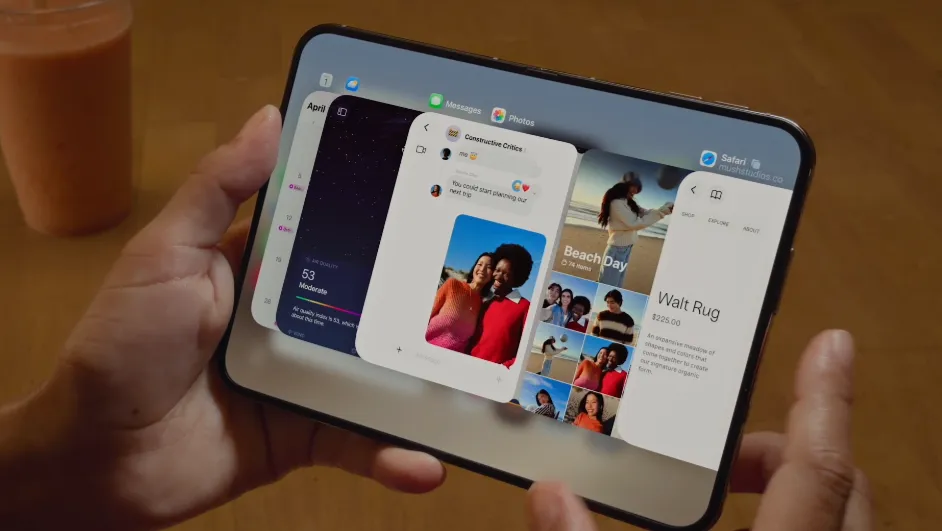
Apple's first foldable iPhone is finally here, and the iPhone Duo is quite different from the regular iPhone lineup.
It folds into a compact phone with a 5.4-inch outer display and opens into a much larger 7.6-inch OLED screen. Inside, Apple has fitted the new A20 Pro chip, a dual-battery system, two 48MP rear cameras and a set of cameras designed specifically around the foldable design.
The iPhone Duo comes with up to 2TB of storage and weighs 254 grams when unfolded. It also supports Apple Pencil, Touch ID, ProMotion and Apple's latest Apple Intelligence features.
Here's a complete look at the iPhone Duo specifications.
iPhone Duo specs at a glance
Specification | iPhone Duo |
|---|---|
Inner display | 7.6-inch Super Retina XDR OLED |
Outer display | 5.4-inch Super Retina XDR OLED |
Refresh rate | ProMotion up to 120Hz |
Processor | A20 Pro |
CPU | 6-core |
GPU | 7-core with Neural Accelerators |
Neural Engine | Dual 16-core |
Rear cameras | 48MP Fusion Main + 48MP Fusion Ultra Wide |
Front camera | 12MP Center Stage |
Inner camera | Under-display FaceTime camera |
Storage | 256GB, 512GB, 1TB, 2TB |
Weight | 254g |
Open thickness | 5.2mm |
Folded thickness | 11.3mm |
Battery | Dual built-in lithium-ion batteries |
Video playback | Up to 44 hours |
Cellular | 5G |
Modem | Apple C2 |
Wi-Fi | Wi-Fi 7 |
Bluetooth | Bluetooth 6 |
Charging | USB-C, MagSafe, Qi2 |
Authentication | Touch ID |
Water resistance | IP68 |
Operating system | iOS 27 |
Display: 7.6-inch foldable OLED
The biggest reason to buy the iPhone Duo is its display.
When unfolded, the phone has a 7.6-inch Super Retina XDR OLED folding display with a resolution of 1878 × 2670 pixels and 430 pixels per inch.
When folded, you get a 5.4-inch Super Retina XDR OLED outer display with a 1398 × 2034 resolution and 460ppi.
Both screens support Apple's ProMotion technology with adaptive refresh rates up to 120Hz.
They also include:
Always-On display
Dynamic Island
HDR
True Tone
Wide color P3
Haptic Touch
2,000,000:1 typical contrast ratio
Up to 3,000 nits peak outdoor brightness
Anti-reflective coating
The inner display also has a nano-texture finish, which Apple says helps reduce glare and reflections and makes the crease less noticeable.
Apple is also adding Apple Pencil support over USB-C, giving the larger display another use case for notes, sketches and document work.
iPhone Duo dimensions and weight
The dimensions change depending on whether the phone is open or folded.
When unfolded
Width: 164.6mm
Height: 117.8mm
Thickness: 5.2mm
Weight: 254g
When folded
Width: 84.1mm
Height: 117.8mm
Thickness: 11.3mm
Weight: 254g
Apple uses a titanium foldable design with a titanium hinge cover. The front uses Ceramic Shield 2, while the back uses Ceramic Shield.
The phone also carries an IP68 rating, meaning it can withstand immersion in up to 6 metres of water for up to 30 minutes under Apple's stated testing conditions.
A20 Pro chip
The iPhone Duo runs on Apple's A20 Pro chip.
The chip has:
6-core CPU
7-core GPU
Neural Accelerators
Dual 16-core Neural Engine
Hardware-accelerated ray tracing
Apple says the A20 Pro's 6-core CPU is up to 20% faster than the A19 Pro, while memory bandwidth is up to 50% higher.
The Duo also uses a vapor-based thermal management system to help handle demanding workloads.
That's particularly useful on a foldable phone because the large inner screen makes gaming, video editing and multitasking more appealing.
iPhone Duo cameras
Apple has given the Duo a 48MP Dual Fusion camera system.
It consists of:
48MP Fusion Main
The main camera has:
26mm focal length
ƒ/1.6 aperture
Sensor-shift optical image stabilization
Hybrid Focus Pixels
24MP and 48MP high-resolution photos
It also provides a 2x optical-quality telephoto option equivalent to 52mm.
48MP Fusion Ultra Wide
The ultra-wide camera has:
13mm focal length
ƒ/2.2 aperture
120-degree field of view
Hybrid Focus Pixels
24MP and 48MP high-resolution photos
48MP macro photography
The system provides up to 2x optical-quality zoom in, 2x optical zoom out and a 4x optical-quality zoom range. Digital zoom goes up to 10x for photos.
New camera features
The Duo's cameras aren't simply about megapixel numbers.
Apple has added several features built around the foldable design.
Duo Preview lets you use the outer display as a preview when taking photos or videos with the rear cameras.
Dual Capture allows the phone to record from the front and rear cameras at the same time, with support for up to 4K Dolby Vision at 30fps.
Smart Take uses Apple's camera processing to help capture and select better shots.
There's also Smart Focus Tracking, Photographic Styles 3 and Center Stage support.
Front cameras
The iPhone Duo has a 12MP Center Stage camera on the outer display.
It supports:
Center Stage
Smart Take
Kid Cue
Photographic Styles 3
4K Dolby Vision video
Dual Capture
Portrait mode
Night mode
Ultra-stabilised video
Apple has also placed an under-display FaceTime camera beneath the inner display.
That means the large folding screen doesn't need a traditional visible camera cutout.
iPhone Duo battery life
The iPhone Duo uses an iPhone-first dual-battery system.
Apple rates it for:
Up to 24 hours of typical use
Up to 44 hours of video playback using the outer display
Up to 31 hours of video playback using the inner display
Up to 37 hours of streamed video with the outer display
Up to 26 hours of streamed video with the inner display
For wired charging, Apple says the Duo can reach 50% charge in around 20 minutes with a 60W-capable adapter or higher.
Using a 35W adapter or higher with MagSafe, it can reach 50% in around 30 minutes.
MagSafe and Qi2 wireless charging are supported at up to 25W.
Storage options
Apple offers four storage configurations:
256GB
512GB
1TB
2TB
That makes the 2TB version particularly interesting for people who shoot a lot of high-resolution video or want to keep large amounts of content locally.
The starting configuration is 256GB, so buyers don't have to jump straight to the higher-capacity versions.
Connectivity
The iPhone Duo supports 5G, Wi-Fi 7 and Bluetooth 6.
Other wireless technologies include:
Apple N1 wireless networking chip
Apple C2 cellular modem
Thread
Second-generation Ultra Wideband
NFC
Express Cards with power reserve
The phone also supports precision dual-frequency GPS along with GLONASS, Galileo, QZSS, BeiDou and NavIC.
For wired connections, the USB-C port supports USB 3 speeds of up to 10Gbps and DisplayPort.
Touch ID instead of Face ID
One of the biggest changes compared with recent iPhones is authentication.
The iPhone Duo uses Touch ID, with the fingerprint sensor built into the side button.
This is also useful for the foldable form factor because the phone can be unlocked whether you're using the outer screen or the larger inner display.
SIM and eSIM
The iPhone Duo does not have a physical SIM card slot.
It supports dual eSIM, with two active eSIMs and support for storing eight or more eSIMs.
That makes the Duo an eSIM-only iPhone, so buyers should check carrier compatibility before switching from a physical SIM.
Apple Intelligence and Siri AI
The Duo is built around Apple's latest Apple Intelligence features.
Apple says its next-generation Apple Intelligence is integrated into apps and uses on-device processing where possible, with Siri AI providing a more conversational assistant experience.
The A20 Pro's Neural Engine is also designed to handle AI workloads directly on the device.
For the Duo, AI isn't just another software feature. The larger display gives those features more room for multitasking, editing and interacting with apps.
iPhone Duo specs vs regular iPhone
The biggest difference isn't simply processing power.
The Duo changes how you use an iPhone.
You can use the 5.4-inch screen for everyday tasks when the phone is closed, then open it to get a 7.6-inch display for multitasking, gaming, video, editing or reading.
Apple has also designed iOS experiences specifically around the foldable form factor.
That makes the display and physical design just as important as the A20 Pro chip or camera hardware.
iPhone Duo specifications: Quick summary
Category | Specification |
|---|---|
Design | Titanium foldable |
Inner screen | 7.6-inch OLED |
Outer screen | 5.4-inch OLED |
Refresh rate | Up to 120Hz |
Processor | A20 Pro |
CPU | 6-core |
GPU | 7-core |
Neural Engine | Dual 16-core |
Main camera | 48MP |
Ultra-wide | 48MP |
Outer front camera | 12MP Center Stage |
Inner camera | Under-display FaceTime |
Storage | 256GB–2TB |
Open thickness | 5.2mm |
Folded thickness | 11.3mm |
Weight | 254g |
Battery | Dual battery |
Video playback | Up to 44 hours |
Charging | USB-C, MagSafe, Qi2 |
Cellular | 5G |
Wi-Fi | Wi-Fi 7 |
Bluetooth | Bluetooth 6 |
Authentication | Touch ID |
Water resistance | IP68 |
Apple Pencil | Supported |
AI | Apple Intelligence + Siri AI |
What stands out about the iPhone Duo specs?
On paper, the Duo looks less like an experimental first-generation foldable and more like a full-fledged iPhone built around a new form factor.
The 7.6-inch 120Hz OLED display, A20 Pro chip, dual 48MP camera system, dual-battery design and up to 2TB of storage give it flagship-level hardware.
But the most interesting specifications are the ones that only make sense because this is a foldable: the two displays, under-display inner camera, dual-battery layout, Touch ID side button and software designed for different screen positions.
That's ultimately what separates the iPhone Duo from simply putting a bigger screen on an iPhone.
For the price and full storage breakdown, see our iPhone Duo price guide. If you're still deciding whether Apple's foldable is worth buying, our main iPhone Duo guide covers the design, cameras, performance, battery and other features in more detail.
Comments
No comments yet — be the first to comment.