
A20 Pro vs A19 Pro: How Much Faster Is Apple's New Chip?
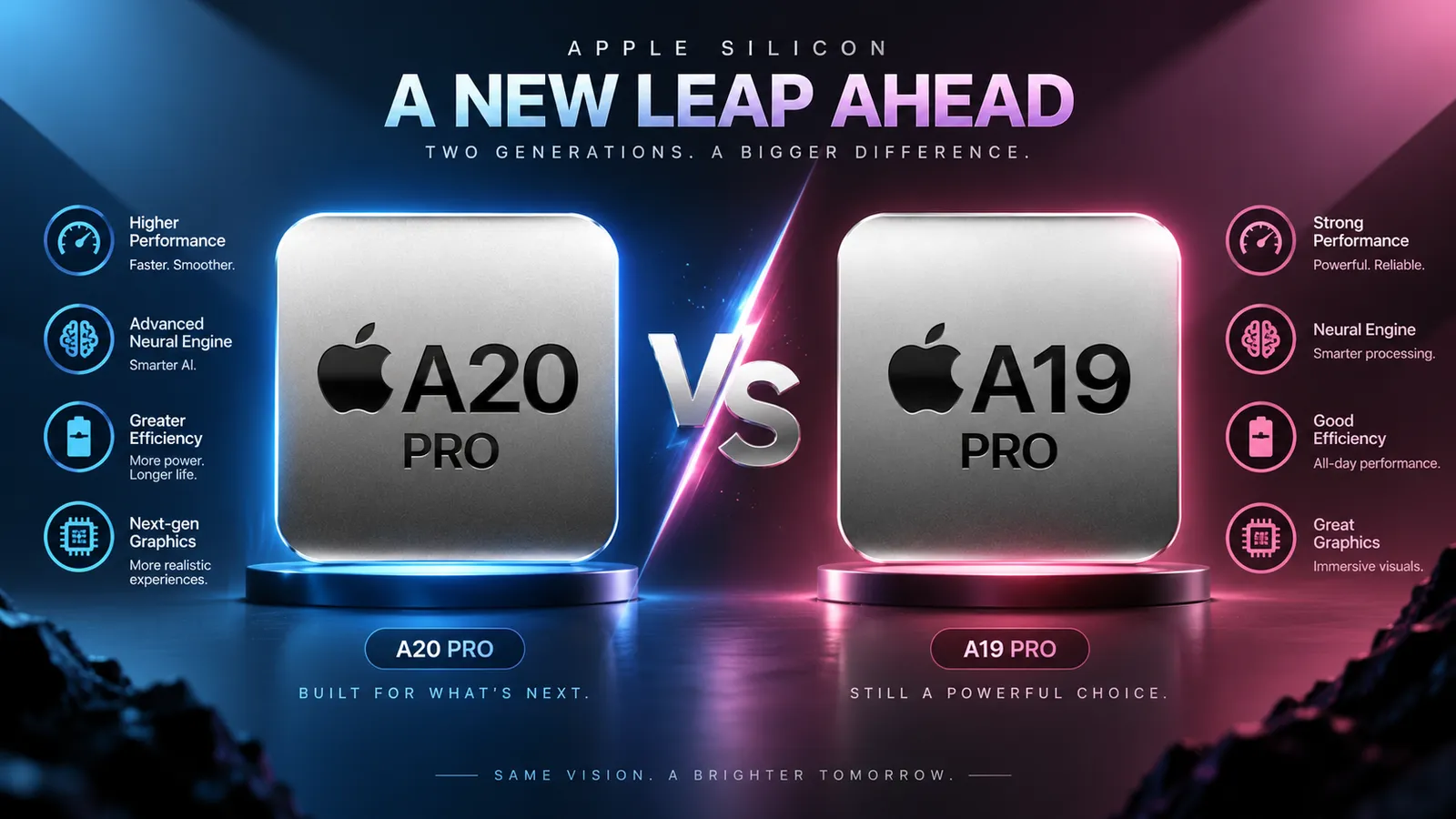
The A20 Pro is Apple's new high-end iPhone chip for 2026, replacing the A19 Pro used in the iPhone 17 Pro and iPhone 17 Pro Max.
At first glance, the two chips look surprisingly similar. Both have a 6-core CPU, hardware-accelerated ray tracing and dedicated Neural Accelerators. But the A20 Pro moves to a 7-core GPU, adds a Dual 16-core Neural Engine, increases memory bandwidth by 50%, and is built using a new 2-nanometer process.
Apple's biggest performance claims are also significant. The A20 Pro GPU is up to 40% faster than A19 Pro, while its Neural Engine provides twice the AI compute. Apple also says the iPhone 18 Pro's new thermal system enables up to 40% better sustained performance than iPhone 17 Pro.
So how much faster is A20 Pro really, and does the upgrade matter if you already have an A19 Pro iPhone?
A20 Pro vs A19 Pro: Quick comparison
Feature | A20 Pro | A19 Pro |
|---|---|---|
Manufacturing process | 2nm | Previous-generation process |
CPU | 6-core | 6-core |
CPU layout | 2 super cores + 4 efficiency cores | 2 performance + 4 efficiency cores |
GPU | 7-core | 6-core |
Neural Accelerators | Yes | Yes |
Neural Engine | Dual 16-core | 16-core |
Neural Engine cores | 32 | 16 |
Ray tracing | Hardware accelerated | Hardware accelerated |
Memory bandwidth | 50% higher than A19 Pro | Baseline |
Sustained performance | Up to 40% better than iPhone 17 Pro | Up to 40% better than previous generation |
Devices | iPhone 18 Pro / 18 Pro Max | iPhone 17 Pro / 17 Pro Max |
Apple's technical specifications confirm the A20 Pro's 6-core CPU, 7-core GPU and Dual 16-core Neural Engine, while the A19 Pro has a 6-core CPU, 6-core GPU and 16-core Neural Engine.
A20 Pro vs A19 Pro: What's actually new?
The upgrade isn't simply about increasing CPU clock speeds.
Apple has changed several parts of the chip at the same time:
New 2nm manufacturing process
7-core GPU instead of 6 cores
New Neural Accelerators integrated into the CPU
Dual 16-core Neural Engine
50% higher memory bandwidth
New chip packaging
Larger vapor chamber in iPhone 18 Pro
These changes target different types of workloads.
The GPU focuses on graphics, the Neural Engine and Neural Accelerators handle AI-related workloads, while the additional memory bandwidth helps move more data around the system.
A20 Pro vs A19 Pro CPU: Is the CPU faster?
Both chips use a 6-core CPU, but that doesn't mean their performance is identical.
The A20 Pro uses two super cores and four efficiency cores, while the A19 Pro uses two performance cores and four efficiency cores.
Apple's current iPhone 18 Pro product page says the A20 Pro provides up to 60% faster 6-core CPU performance in its comparison material.
That's a headline figure rather than a guarantee that every CPU task will be 60% faster.
For example, opening an email app doesn't suddenly become 60% faster just because the processor is more capable.
The difference is more relevant to workloads that put sustained pressure on the CPU.
Where the CPU upgrade matters
You are more likely to benefit from the additional CPU performance when:
Exporting video
Editing large photos
Running demanding AI workloads
Compressing or processing files
Running complex applications
Multitasking between demanding apps
For basic phone use, A19 Pro is already extremely capable.
A20 Pro vs A19 Pro GPU: The bigger graphics upgrade
The GPU comparison is easier to understand.
A19 Pro has a 6-core GPU with Neural Accelerators.
A20 Pro moves to a 7-core GPU with Neural Accelerators. Both support hardware-accelerated ray tracing.
Apple says the A20 Pro GPU is up to 40% faster than A19 Pro.
That's a meaningful upgrade for graphics-heavy workloads.
It can help with:
High-end mobile games
Ray-traced graphics
3D applications
Video effects
Graphics rendering
GPU-accelerated AI workloads
The benefit is particularly relevant to the iPhone 18 Pro because Apple has also improved its thermal system.
A20 Pro gaming performance vs A19 Pro
Gaming is one of the clearest examples of where the new chip can matter.
A19 Pro already provides strong gaming performance. Apple introduced it with a 6-core GPU, Neural Accelerators and hardware ray tracing, while its vapor-chamber thermal design was intended to support sustained performance.
A20 Pro adds another GPU core and Apple says graphics performance is up to 40% higher.
But the bigger change may come from cooling.
The iPhone 18 Pro's vapor chamber has three times the surface area of the previous generation and is paired with new chip packaging designed to improve heat flow. Apple says this enables up to 40% better sustained performance than iPhone 17 Pro.
That means the improvement isn't only about achieving a higher peak frame rate.
It's about keeping the phone performing well during longer gaming sessions.
A20 Pro vs A19 Pro AI performance
This is arguably the biggest architectural change.
A19 Pro has a 16-core Neural Engine.
A20 Pro moves to a Dual 16-core Neural Engine, giving it 32 Neural Engine cores in total. Apple says this provides twice the AI processing power of A19 Pro.
A20 Pro also includes Neural Accelerators and 50% higher memory bandwidth.
Apple says these changes improve on-device intelligence, Apple Intelligence and computational photography.
That makes the A20 Pro upgrade particularly relevant as more AI processing moves onto the phone.
What can the extra AI performance be used for?
Potential workloads include:
On-device AI models
Apple Intelligence
Computational photography
Image processing
Voice processing
Intelligent camera features
Generative AI workloads
The important difference is that A20 Pro is being designed around a future where AI is a larger part of everyday phone use.
A20 Pro has 50% more memory bandwidth
Apple says A20 Pro provides 50% more memory bandwidth than A19 Pro.
Memory bandwidth describes how quickly data can move between the processor and memory.
This becomes important when the chip is dealing with large datasets.
Think about:
High-resolution photos
4K and high-frame-rate video
Large AI models
3D graphics
Complex games
A faster processor is useful only if the rest of the system can supply it with data quickly enough.
The A20 Pro's higher memory bandwidth helps remove some of that limitation.
A20 Pro vs A19 Pro: What does 2nm change?
The A20 Pro is built using a 2nm process, while A19 Pro belongs to the previous process generation. Apple describes the new process as part of the A20 Pro's performance and efficiency improvements.
The important point is that 2nm doesn't automatically mean "40% faster."
Process technology is one part of the chip design.
A20 Pro combines the newer process with:
A new CPU design
One additional GPU core
More AI hardware
Higher memory bandwidth
New packaging
Improved cooling
So the performance improvement comes from the entire platform rather than the manufacturing process alone.
A20 Pro vs A19 Pro performance: The numbers
Here's how Apple's published figures compare.
There is an important qualification here.
These figures aren't all measuring exactly the same thing. The 40% GPU figure compares A20 Pro with A19 Pro, the 50% memory-bandwidth figure also compares with A19 Pro, and the 2x AI figure means a 100% increase in compute relative to A19 Pro. The 40% sustained-performance figure compares iPhone 18 Pro with iPhone 17 Pro.
So you shouldn't add these percentages together or describe A20 Pro as "230% faster."
A20 Pro vs A19 Pro benchmark results
There is a difference between Apple's performance claims and independent benchmark results.
Apple has published architectural specifications and performance claims for A20 Pro, but those numbers shouldn't be presented as third-party benchmark scores.
For an actual benchmark comparison, you would want independent tests covering:
Geekbench single-core
Geekbench multi-core
GPU tests
AI benchmarks
Gaming frame rates
Long-duration thermal tests
Those tests can reveal how the chips behave under controlled workloads.
Until independent testing provides a complete set of results, Apple's figures are the best confirmed indication of the expected performance difference.
A20 Pro vs A19 Pro sustained performance
This is where the iPhone 18 Pro's chip story gets more interesting.
The A19 Pro already introduced a vapor chamber and Apple said the iPhone 17 Pro could deliver up to 40% better sustained performance than the previous generation.
Apple is now taking the same idea further.
The iPhone 18 Pro's new vapor chamber has three times the surface area of the previous generation. The A20 Pro's custom packaging also places the silicon die and memory side by side, improving the heat path into the cooling system.
Apple says this combination provides up to 40% better sustained performance than iPhone 17 Pro.
For users, this matters more during long workloads than during a short benchmark run.
Why sustained performance matters
Imagine two phones running the same demanding game.
Phone A produces a very high frame rate for the first few minutes but reduces performance after the device heats up.
Phone B starts at a similar level but maintains its performance for much longer.
For an actual gaming session, Phone B may provide the better experience.
That's why the A20 Pro's thermal system deserves as much attention as the raw CPU and GPU specifications.
The chip is designed to stay under heavy load for longer.
A20 Pro vs A19 Pro for video editing
Video editing is another workload that can take advantage of the new chip.
The iPhone 18 Pro supports demanding video formats including 4K Dolby Vision up to 120fps, ProRes and ProRes RAW.
Working with this footage requires substantial processing power.
The A20 Pro's faster GPU, higher memory bandwidth and improved sustained performance can help with:
Timeline playback
Video effects
Rendering
Exporting
High-resolution footage
AI-powered video processing
A19 Pro is still capable of handling demanding video work.
The difference is that A20 Pro provides more headroom for heavier workflows.
A20 Pro vs A19 Pro for photography
The performance upgrade also affects the camera.
The iPhone 18 Pro introduces a 48MP Fusion Main camera with variable aperture, Pro Controls and Photographic Styles 3.
A20 Pro's Neural Engine is designed to accelerate computational photography.
That means the processor helps with more than app performance. It contributes to how quickly and effectively the phone processes camera data.
The new AI hardware can therefore matter even if you never play a game or edit video.
A20 Pro vs A19 Pro battery efficiency
A newer chip doesn't automatically guarantee longer battery life.
Battery life depends on the entire phone, including:
Display
Battery capacity
Modem
Software
Camera system
Processor efficiency
Workload
Apple says the A20 Pro's silicon efficiencies contribute to the iPhone 18 Pro's battery improvements. The company rates iPhone 18 Pro for up to 36 hours of video playback and iPhone 18 Pro Max for up to 45 hours.
For comparison, Apple rates iPhone 17 Pro at up to 31 hours and iPhone 17 Pro Max at up to 37 hours of video playback.
So there is a noticeable battery-life improvement between the generations, but it would be misleading to attribute all of it to A20 Pro alone.
A20 Pro vs A19 Pro: Which chip is better for AI?
A20 Pro.
This is one of the clearest wins.
A19 Pro has a 16-core Neural Engine.
A20 Pro has a Dual 16-core Neural Engine and Apple says it delivers twice the AI compute, along with Neural Accelerators and 50% more memory bandwidth.
If Apple continues increasing the amount of AI processing performed directly on the iPhone, this additional hardware should become increasingly useful.
A20 Pro vs A19 Pro: Which chip is better for gaming?
A20 Pro, based on Apple's published specifications and performance claims.
The new chip has:
7-core GPU instead of 6-core
Up to 40% faster GPU performance
Neural Accelerators
Hardware ray tracing
Higher memory bandwidth
Improved thermal management
The cooling improvements are especially relevant for long gaming sessions.
However, actual game performance will depend on the game, its optimisation and whether it supports the relevant graphics features.
A20 Pro vs A19 Pro: Is the upgrade noticeable?
It depends on what you do with your iPhone.
For everyday users
Probably not dramatically.
Both chips are powerful enough for:
Messaging
Social media
Web browsing
Streaming
Photography
Normal multitasking
A19 Pro is not suddenly slow.
For gamers
The difference is more interesting.
The faster GPU and improved sustained performance give A20 Pro more headroom.
For creators
Video editors and photographers have more reason to care because their workloads can put sustained pressure on CPU, GPU and memory.
For AI users
This is where A20 Pro has the clearest architectural advantage.
The doubled Neural Engine compute and new Neural Accelerators are built around on-device AI.
Should you upgrade from iPhone 17 Pro to iPhone 18 Pro for A20 Pro?
If A20 Pro is the only reason, probably not for most people.
The A19 Pro remains a high-performance chip. Apple itself positioned it as its most capable iPhone chip when the iPhone 17 Pro launched, with strong sustained performance for gaming, video editing and local AI models.
The A20 Pro becomes a more convincing upgrade when combined with the other iPhone 18 Pro changes.
Those include:
Variable-aperture 48MP Main camera
Photographic Styles 3
New Pro Controls
Improved low-light video
New AI capabilities
Larger thermal system
Longer battery life
The chip alone isn't the whole upgrade story.
A20 Pro vs A19 Pro: Who should choose which?
Choose A20 Pro if you:
Want the latest iPhone Pro performance
Play demanding games
Edit video regularly
Use on-device AI heavily
Want more long-term performance headroom
Plan to keep the phone for several years
Stay with A19 Pro if you:
Already own an iPhone 17 Pro
Mostly use everyday apps
Don't play demanding games
Don't edit video regularly
Are satisfied with current AI performance
Don't need the other iPhone 18 Pro upgrades
For someone buying a new Pro iPhone, A20 Pro is the obvious choice if the price difference isn't an issue.
For an existing iPhone 17 Pro owner, the decision depends much more on the camera, battery and other new features.
A20 Pro vs A19 Pro: The bottom line
The A20 Pro is a meaningful step forward from A19 Pro, but the upgrade isn't simply about one big benchmark number.
The new chip moves to a 2nm process, adds a seventh GPU core, doubles the Neural Engine compute, increases memory bandwidth by 50% and introduces a new packaging design that works with a larger vapor chamber.
Apple's clearest claims are:
Up to 40% faster GPU performance
2x AI compute
50% higher memory bandwidth
Up to 40% better sustained performance on iPhone 18 Pro
A claimed up to 60% CPU performance increase in Apple's iPhone 18 Pro comparison material
The biggest practical difference is likely to appear in gaming, AI, video editing and other sustained workloads.
If you already own an iPhone 17 Pro, A20 Pro by itself isn't a must-have upgrade. But if you're buying a new Pro iPhone, the A20 Pro gives the iPhone 18 Pro more processing and thermal headroom for the years ahead.
Comments
No comments yet — be the first to comment.