
A20 Pro Performance: How Fast Is Apple's New iPhone 18 Pro Chip?
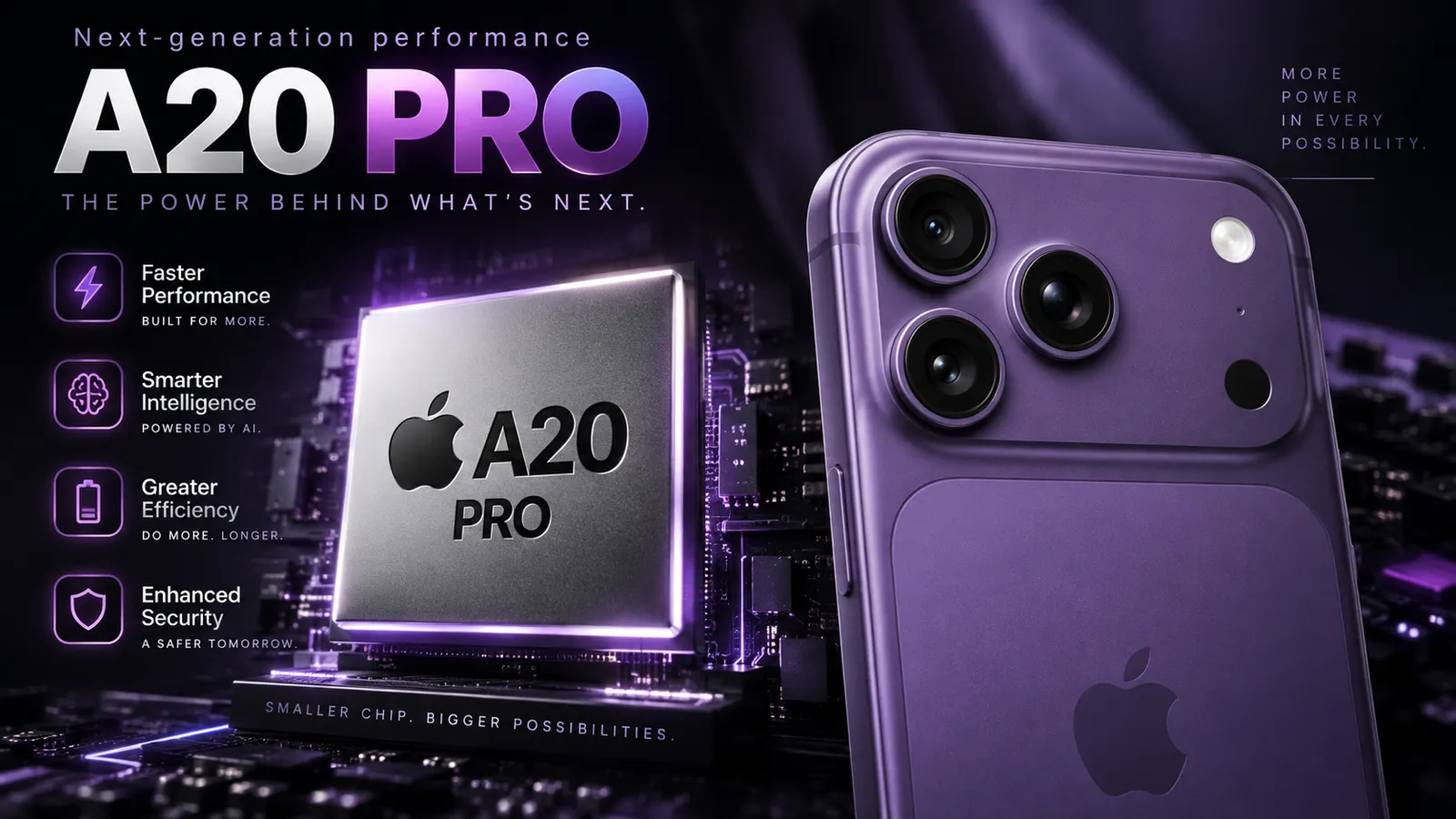
The A20 Pro is the processor behind Apple's iPhone 18 Pro and iPhone 18 Pro Max, and Apple is positioning it as a major performance jump over the previous generation.
The chip combines a 6-core CPU, 7-core GPU with Neural Accelerators, a Dual 16-core Neural Engine, hardware-accelerated ray tracing and 50% higher memory bandwidth than A19 Pro. Apple also moved the chip to a 2nm manufacturing process and paired it with a much larger vapor chamber to improve sustained performance.
Apple's headline numbers are impressive: the A20 Pro's GPU is up to 40% faster than A19 Pro, while the new thermal system enables up to 40% better sustained performance than iPhone 17 Pro. Apple's India product page also claims up to 60% faster CPU performance for iPhone 18 Pro in its comparison materials.
But what do those numbers actually mean for gaming, AI, photography and everyday use?
A20 Pro performance at a glance
Feature | A20 Pro |
|---|---|
Manufacturing process | 2nm |
CPU | 6-core |
CPU configuration | 2 super cores + 4 efficiency cores |
GPU | 7-core |
Neural Accelerators | Yes |
Neural Engine | Dual 16-core |
Hardware ray tracing | Yes |
Memory bandwidth | 50% higher than A19 Pro |
Sustained performance | Up to 40% better than iPhone 17 Pro |
Device | iPhone 18 Pro and 18 Pro Max |
Apple's technical specifications confirm the 6-core CPU, 7-core GPU with Neural Accelerators, Dual 16-core Neural Engine and hardware-accelerated ray tracing.
How fast is the A20 Pro?
There isn't one single A20 Pro performance number.
CPU performance, GPU performance, AI processing and sustained performance are different measurements. Apple reports improvements across all of these areas rather than claiming that every task is simply 40% or 60% faster.
The key figures Apple gives are:
Up to 60% faster CPU performance in Apple's iPhone 18 Pro comparison.
Up to 40% faster GPU performance than A19 Pro.
2x AI compute from the new Dual 16-core Neural Engine compared with A19 Pro.
50% higher memory bandwidth than A19 Pro.
Up to 40% better sustained performance than iPhone 17 Pro with the new thermal system.
These figures shouldn't be treated as a universal speed increase. A messaging app, a demanding 3D game and an AI workload put very different demands on the processor.
A20 Pro CPU performance
The A20 Pro has a 6-core CPU with two super cores and four efficiency cores.
The basic idea remains familiar.
The higher-performance cores handle demanding work, while the efficiency cores handle lighter workloads with lower power requirements.
Apple's India product page lists the A20 Pro as providing up to 60% faster 6-core CPU performance in its comparison material.
That's a large figure, but it's important to understand what "up to" means.
You shouldn't expect every app to open 60% faster.
CPU improvements are more useful when an application actually needs substantial processing power.
Examples include:
Video rendering
Photo processing
AI workloads
Large file operations
Complex games
Data-heavy applications
Multitasking
For basic tasks such as opening Messages or browsing Safari, recent iPhones are already fast enough that the difference may be difficult to notice.
A20 Pro GPU performance
The A20 Pro's GPU has seven cores and includes Neural Accelerators and hardware-accelerated ray tracing.
Apple says the GPU is up to 40% faster than A19 Pro.
This is one of the more important improvements for gamers.
A faster GPU can handle more complex graphics calculations, higher workloads and demanding rendering effects.
That can help with:
3D games
High-resolution gaming
Ray-traced graphics
Video effects
3D applications
Graphics-intensive editing
But peak GPU speed isn't the whole story.
A phone needs to maintain that performance when the workload continues for a long time.
That's where the iPhone 18 Pro's cooling system becomes important.
A20 Pro gaming performance
The iPhone 18 Pro is designed for demanding games, and Apple specifically connects its new thermal system with high-intensity gaming.
The A20 Pro provides the processing and graphics performance, while the vapor chamber helps move heat away from the chip.
This matters because gaming workloads can remain high for extended periods.
A phone might deliver excellent performance for the first few minutes and then reduce processor speed as temperatures rise.
The iPhone 18 Pro is designed to reduce that performance drop.
Apple says the new thermal system enables up to 40% better sustained performance than iPhone 17 Pro.
What does sustained performance mean?
Sustained performance is simply how well a device maintains high performance over time.
Imagine playing a demanding game for 30 minutes.
If the phone starts extremely fast but slows down significantly after it heats up, peak performance doesn't tell the whole story.
A better cooling system gives the processor more thermal headroom.
That is why the A20 Pro story isn't just about its CPU and GPU.
The new vapor chamber makes a big difference
Apple has redesigned the thermal system around the A20 Pro.
The new vapor chamber has three times the surface area of the previous generation on iPhone 17 Pro. Apple also says it uses more thermally conductive materials.
The A20 Pro's custom packaging is also designed to improve heat flow.
Apple says the silicon die and memory are positioned side by side, removing the memory from the chip's thermal path and allowing the A20 Pro to attach directly to the vapor chamber.
The result is a better path for heat to leave the processor.
That's particularly useful for:
Long gaming sessions
AI workloads
Video rendering
High-resolution photo processing
Other sustained workloads
A20 Pro and 2nm performance
The A20 Pro is Apple's first iPhone Pro chip built using the latest 2nm process technology.
The move to 2nm is important because newer semiconductor manufacturing technology can give chip designers more opportunities to improve performance and efficiency.
But the A20 Pro's performance shouldn't be attributed to 2nm alone.
Apple has combined the new process with:
A redesigned CPU
7-core GPU
Neural Accelerators
Dual 16-core Neural Engine
50% higher memory bandwidth
New chip packaging
Larger vapor chamber
The performance gains come from the complete platform.
A20 Pro AI performance
AI is one of the biggest areas where Apple has changed the A20 Pro.
The chip has a Dual 16-core Neural Engine, giving it 32 Neural Engine cores in total.
Apple says this provides twice the AI compute of A19 Pro.
The chip also adds Neural Accelerators and 50% higher memory bandwidth.
Apple says these improvements provide faster Apple Intelligence and more processing power for on-device AI.
That means the A20 Pro isn't simply designed to make games faster.
It's also designed around Apple's growing use of AI directly on the device.
Why AI performance needs more than a faster CPU
AI workloads can be very different from traditional applications.
Instead of relying primarily on general-purpose CPU calculations, many AI operations benefit from specialised hardware.
That's why the A20 Pro uses several processing components:
CPU: General-purpose processing.
GPU: Parallel graphics and compute workloads.
Neural Accelerators: Dedicated AI-related calculations integrated into the chip.
Neural Engine: Specialised machine-learning processing.
Apple's Dual 16-core Neural Engine is designed to accelerate on-device AI models and computational photography.
This hardware becomes increasingly important as Apple adds more AI features.
A20 Pro and Apple Intelligence
Apple is pushing more AI processing directly onto the iPhone.
The A20 Pro's Neural Engine and Neural Accelerators are designed to handle these workloads locally.
Apple says the A20 Pro provides faster Apple Intelligence through its Neural Accelerators, Dual 16-core Neural Engine and higher memory bandwidth.
For users, that can translate into faster processing for AI-powered features rather than simply making the phone feel faster everywhere.
The distinction matters.
You may not notice the A20 Pro's AI hardware when scrolling through a website, but you could notice its benefits in features that require substantial on-device processing.
50% more memory bandwidth
Another important A20 Pro improvement is 50% higher memory bandwidth compared with A19 Pro.
Memory bandwidth describes how quickly data can move between the processor and memory.
That matters when the CPU, GPU or Neural Engine needs to process large amounts of information.
High-bandwidth workloads include:
AI models
High-resolution images
Video editing
3D graphics
Large games
Computational photography
A powerful processor needs to be fed data quickly enough to keep its processing cores busy.
The increase in memory bandwidth helps the A20 Pro handle those workloads more effectively.
A20 Pro performance for photography
The processor also has a major role in the iPhone 18 Pro's camera.
The phone's camera system includes a 48MP Fusion Main camera with variable aperture, a 48MP Ultra Wide and a 48MP Telephoto. It also adds features such as Photographic Styles 3, Smart Focus Tracking, Pro Controls and Apple Reference Image.
The A20 Pro provides the processing needed for computational photography.
Apple specifically says its new Neural Engine accelerates computational photography.
So camera improvements and chip improvements are closely connected.
The processor isn't just responsible for running apps in the background. It helps create the final image and process camera data.
A20 Pro performance for video editing
The iPhone 18 Pro can record high-end video formats including 4K Dolby Vision at up to 120fps, ProRes and ProRes RAW.
Processing and editing this type of footage can put considerable pressure on a mobile processor.
The A20 Pro's CPU and GPU provide the raw compute power, while its memory bandwidth helps move large amounts of video data.
The improved thermal system becomes useful when you're rendering or exporting video for an extended period.
For people who regularly edit video directly on their iPhone, this is a more meaningful performance upgrade than it is for someone who mainly uses the phone for social media.
A20 Pro performance vs A19 Pro
Here's the key comparison based on Apple's published claims:
Area | A20 Pro improvement |
|---|---|
CPU | Up to 60% faster in Apple's iPhone 18 Pro comparison |
GPU | Up to 40% faster than A19 Pro |
AI compute | 2x A19 Pro |
Memory bandwidth | 50% higher than A19 Pro |
Sustained performance | Up to 40% better than iPhone 17 Pro |
There is an important distinction here.
The CPU figure is Apple's product-page comparison for the A20 Pro, while the GPU and AI figures are stated against A19 Pro. The 40% sustained-performance figure compares the iPhone 18 Pro thermal system with iPhone 17 Pro. These figures should not be combined into one overall "A20 Pro is X% faster" number.
A20 Pro benchmark results: What should you expect?
At launch, Apple's own performance figures are the clearest confirmed numbers available in the sources above.
Third-party benchmark results can be useful once independent testing is available, but benchmark scores shouldn't replace real-world testing.
A benchmark can measure:
Single-core CPU performance
Multi-core CPU performance
GPU performance
AI performance
Sustained performance
Different tests can produce very different results depending on the workload and thermal conditions.
For that reason, a future benchmark comparison between A20 Pro and A19 Pro will be more useful if it includes both short benchmark runs and longer sustained tests.
For now, Apple's published numbers give us a clear picture of where the company expects the biggest gains: CPU, graphics, AI, memory bandwidth and sustained performance.
How much faster will the iPhone 18 Pro feel?
This depends heavily on what you're doing.
Messaging and browsing
Probably not dramatically different.
The iPhone 17 Pro is already fast enough that basic applications run quickly.
Gaming
More noticeable.
The faster GPU and improved sustained performance can matter during demanding games and longer sessions.
AI
Potentially much more noticeable over time.
The new Neural Engine and Neural Accelerators are designed specifically for heavier on-device AI workloads.
Photo editing
Useful for computationally demanding edits and large images.
Video editing
One of the areas most likely to benefit from the additional CPU, GPU and thermal headroom.
Long-term use
The additional performance gives the iPhone 18 Pro more headroom as applications become more demanding.
Is A20 Pro the fastest smartphone chip?
Apple says the A20 Pro's 6-core CPU is faster than the competition, but that is Apple's own comparison rather than an independent benchmark result.
So it is better not to turn that statement into an absolute claim that the A20 Pro is objectively the fastest mobile processor in every workload.
Different smartphone chips can lead in different tests.
The more useful question is where A20 Pro is strong.
Based on Apple's specifications and performance claims, its strengths are:
High CPU performance
Strong GPU performance
Dedicated AI hardware
High memory bandwidth
Hardware ray tracing
Sustained performance
Tight integration with Apple's camera and AI software
Does A20 Pro improve battery efficiency?
The A20 Pro is designed with efficiency in mind, but battery life isn't determined by the processor alone.
Apple says the new iPhone 18 Pro battery designs use silicon efficiencies from A20 Pro alongside other hardware changes.
The iPhone 18 Pro is rated for up to 36 hours of video playback, while the iPhone 18 Pro Max reaches up to 45 hours according to Apple's launch materials.
The larger battery capacity in the Pro Max and other hardware changes also contribute to those results.
So it would be inaccurate to say "2nm A20 Pro gives you X more hours of battery."
The processor is one part of the system.
Who will benefit most from A20 Pro performance?
Gamers
The combination of the 7-core GPU, ray tracing and improved thermal system makes the A20 Pro particularly relevant to demanding games.
Video creators
High-resolution video recording, editing and exporting can benefit from additional CPU, GPU and sustained performance.
AI users
The Dual 16-core Neural Engine and Neural Accelerators are designed for exactly this workload.
Photographers
Computational photography depends heavily on specialised processing.
Everyday users
You'll still benefit from a fast and responsive phone, but you may not notice the full performance increase during basic tasks.
Should iPhone 17 Pro owners upgrade for A20 Pro?
If performance is the only reason you're considering an upgrade, most iPhone 17 Pro owners probably don't need to rush.
The 17 Pro is already a high-performance phone.
The A20 Pro becomes a stronger reason to upgrade if you:
Play demanding games regularly
Edit video on your phone
Use on-device AI heavily
Work with large files
Want better sustained performance
Keep your phone for several years
If your workload is mainly messaging, browsing, photography and social media, the difference is less compelling.
The new camera system, display and other iPhone 18 Pro features may matter more than the processor alone.
A20 Pro performance: The bottom line
The A20 Pro is a substantial performance upgrade, but its biggest strength isn't one isolated benchmark number.
It's the combination of CPU performance, GPU performance, AI hardware, memory bandwidth and sustained performance.
Apple says the GPU is up to 40% faster than A19 Pro, AI compute doubles, memory bandwidth increases by 50%, and the new thermal system provides up to 40% better sustained performance than iPhone 17 Pro.
The larger vapor chamber is particularly interesting because it addresses a common problem with powerful mobile processors: maintaining performance after the device heats up.
For ordinary tasks, you probably won't feel the full A20 Pro upgrade.
For gaming, AI, photography and video work, the difference should be much easier to appreciate.
And as Apple continues moving more demanding AI processing onto the device, the A20 Pro's specialised hardware may become more important over the life of the iPhone 18 Pro than the initial speed increase alone.
Comments
No comments yet — be the first to comment.