
A20 Pro Neural Engine Explained: What It Means for Apple Intelligence
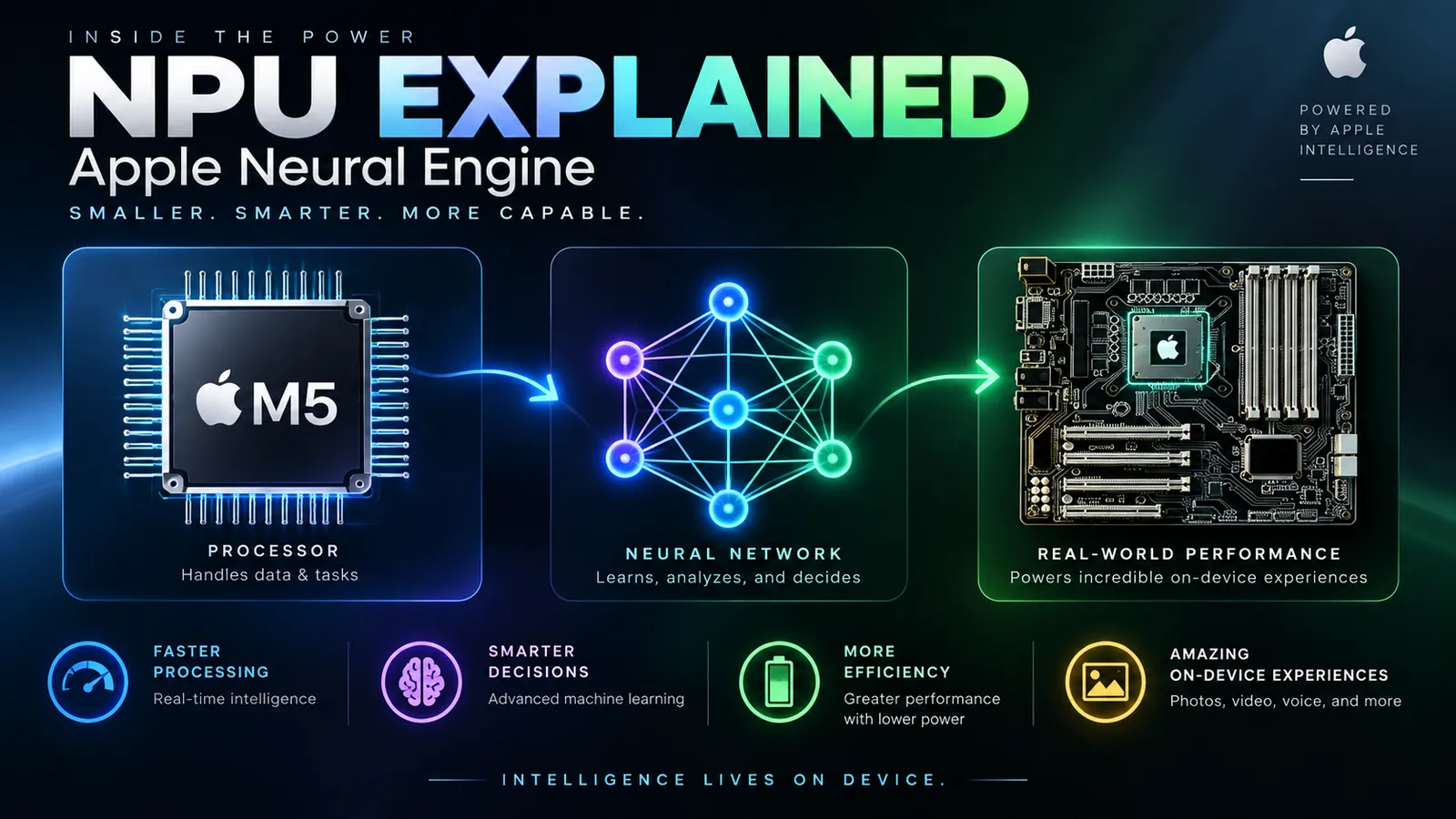
Apple’s A20 Pro chip is not just about faster CPU and GPU performance. One of its biggest changes is the new Dual 16-core Neural Engine, which Apple says provides twice the AI compute of the A19 Pro.
That matters because Apple is putting more AI processing directly on the iPhone. Features such as Siri AI, intelligent photo editing, image generation and other Apple Intelligence tools increasingly depend on the phone being able to process AI models quickly without sending every request to the cloud.
So, what exactly does the A20 Pro Neural Engine do, and how does it change Apple Intelligence on the iPhone 18 Pro?
What is the A20 Pro Neural Engine?
The Neural Engine is a dedicated part of Apple's silicon designed to handle machine-learning and AI workloads.
Instead of relying entirely on the CPU or GPU for AI tasks, Apple uses the Neural Engine to process certain machine-learning operations more efficiently.
The A20 Pro takes this further with a Dual 16-core Neural Engine, giving the chip 32 Neural Engine cores in total. Apple says this provides twice the AI processing power of the Neural Engine in A19 Pro.
That doesn't mean every AI feature will suddenly run twice as fast. The actual improvement depends on the application, model and workload.
The important change is that Apple has significantly increased the hardware available for on-device AI.
A20 Pro Neural Engine vs A19 Pro
Here's the basic difference:
Feature | A19 Pro | A20 Pro |
|---|---|---|
Neural Engine | 16-core | Dual 16-core |
Total Neural Engine cores | 16 | 32 |
AI compute | Previous generation | Up to 2x A19 Pro |
CPU | 6-core | 6-core |
GPU | 6-core | 7-core |
Neural Accelerators | Yes | Yes |
Memory bandwidth | Previous generation | 50% higher |
Manufacturing process | 3nm generation | 2nm |
Apple specifically says the A20 Pro's Dual 16-core Neural Engine delivers 2x the AI processing power of A19 Pro. The chip also gets Neural Accelerators in its CPU and 50 percent more memory bandwidth, giving AI workloads more resources beyond the Neural Engine itself.
Why does Apple Intelligence need a faster Neural Engine?
Apple Intelligence is not a single feature. It is a collection of AI-powered capabilities that work across the operating system and apps.
The iPhone 18 Pro uses Apple Intelligence for features such as Siri AI, intelligent image processing, image generation and other AI-assisted tasks. Apple says the next generation of Apple Intelligence is designed around the user, with processing performed on-device where possible and Private Cloud Compute used when additional cloud processing is required.
That makes the Neural Engine important for three main reasons:
Faster processing of supported AI workloads
More room for complex on-device AI models
Better performance without depending entirely on a remote server
The goal isn't simply to make an AI chatbot respond faster. AI is becoming part of normal phone functions, so the processor needs to handle many smaller AI tasks throughout the day.
On-device AI is the big reason this matters
One of Apple's main approaches to AI is to perform as much processing as possible directly on the device.
That's useful for both performance and privacy.
When an AI task can run on the iPhone itself, the device doesn't necessarily need to send the data to a remote server and wait for a response.
Apple's current Apple Intelligence approach combines on-device processing with Private Cloud Compute for requests that require more processing power.
The A20 Pro gives the iPhone more local processing capacity before that cloud processing is needed.
This is particularly relevant as AI features become more capable.
How the Neural Engine helps Siri AI
The new Siri AI is one of the clearest examples of where Apple's AI hardware matters.
Apple describes Siri AI as a new version of Siri powered by Apple Intelligence, with a greater focus on personal context, conversational interaction and more capable assistance. It is rolling out with iOS 27.
The Neural Engine doesn't work alone here. Siri AI can use different parts of the A20 Pro depending on the task, along with Apple's software frameworks and cloud infrastructure when required.
But having more dedicated AI compute gives Apple more room to run AI processing locally.
That could become increasingly useful as Siri handles more complex requests instead of simply responding to basic voice commands.
What about AI photo editing?
Computational photography has relied on machine learning for years, and the A20 Pro continues that trend.
Apple specifically says the new Neural Engine accelerates on-device AI models and computational photography.
That means the Neural Engine can contribute to tasks such as:
Understanding what's in an image
Recognising subjects and objects
Improving image processing
AI-assisted photo editing
Generative image features
Applying intelligent camera effects
The important point is that the Neural Engine isn't only there for Siri.
It supports AI processing throughout the phone.
AI image generation also benefits
Apple Intelligence includes image-generation features, and the A20 Pro is designed to handle more demanding AI workloads on the device.
Apple says A20 Pro's Dual 16-core Neural Engine is designed to accelerate on-device AI models, while the overall chip architecture provides more memory bandwidth and Neural Accelerators as well.
For users, the result should be less about seeing a "Neural Engine" option in the settings and more about AI features becoming faster and more responsive.
The Neural Engine isn't the only AI hardware in A20 Pro
This is an important distinction.
It would be inaccurate to think of the Neural Engine as the entire AI system inside A20 Pro.
Apple has designed several parts of the chip to contribute to AI workloads.
Neural Engine
The Dual 16-core Neural Engine is the dedicated machine-learning engine and provides the headline 2x AI compute improvement over A19 Pro.
Neural Accelerators
The A20 Pro's CPU and GPU architecture also includes Neural Accelerators. Apple highlights these alongside the Neural Engine as part of the reason Apple Intelligence runs faster.
CPU
The 6-core CPU handles general-purpose processing and can work alongside the AI hardware for tasks that aren't suited to specialised accelerators.
GPU
The 7-core GPU handles graphics workloads and can also contribute to certain AI workloads.
Memory bandwidth
A20 Pro has 50 percent more memory bandwidth than A19 Pro. That's important because larger and more complex AI models need to move data quickly between processing units and memory.
The result is an AI-focused chip rather than a phone that simply has one faster Neural Engine.
Why memory bandwidth matters for AI
AI models work with large amounts of data.
Having more processing cores doesn't automatically solve the entire problem. Those processing units also need to access data quickly.
Apple says A20 Pro has 50 percent more memory bandwidth than A19 Pro. That gives the chip more data throughput to work with while running demanding workloads.
This is one reason it's better to look at the entire A20 Pro architecture rather than focusing only on the "32 Neural Engine cores" headline.
The Neural Engine provides the compute. Higher memory bandwidth helps feed that compute.
Does 2x AI compute mean Apple Intelligence is twice as fast?
Not necessarily.
This is one of the easiest specifications to misunderstand.
Apple's claim is that the new Neural Engine provides 2x the AI processing power of A19 Pro. That does not mean every Apple Intelligence feature will complete in half the time.
Real-world performance depends on:
The AI model being used
Whether processing happens on-device
How much of the workload uses the Neural Engine
Memory bandwidth
CPU and GPU involvement
Software optimisation
Whether Private Cloud Compute is required
So, it's better to think of 2x AI compute as giving Apple substantially more hardware capacity for AI rather than promising a universal 2x speed increase.
A20 Pro and Apple Intelligence privacy
The Neural Engine also fits into Apple's approach to private AI.
Apple Intelligence uses a combination of on-device processing and Private Cloud Compute. When a task can be handled locally, the iPhone can process it without sending the request to Apple's cloud infrastructure. For more demanding requests, Apple can use Private Cloud Compute.
That makes faster on-device AI hardware useful beyond speed.
More capable local processing means more AI work can potentially happen on the iPhone itself.
Apple has positioned this combination of local processing and Private Cloud Compute as a key part of its privacy approach to AI.
Will you notice the Neural Engine in everyday use?
Probably not as a standalone feature.
You won't open Settings and see "Neural Engine" running.
Instead, its impact should appear through the features that use AI.
For example, you may notice improvements when:
Using Siri AI
Editing photos with AI tools
Generating images
Processing complex camera features
Running AI-powered productivity features
Using other Apple Intelligence features
The biggest benefits will likely appear as Apple's AI software becomes more capable.
In other words, the Neural Engine is infrastructure for Apple's AI features rather than a feature you directly interact with.
A20 Pro Neural Engine: Is it a big upgrade?
For Apple Intelligence, yes.
The move from a 16-core Neural Engine in A19 Pro to a Dual 16-core Neural Engine with 32 total cores is one of the biggest changes in A20 Pro's AI hardware. Apple rates the new design at twice the AI compute of A19 Pro.
But the Neural Engine is only one part of the upgrade.
A20 Pro also brings:
2nm manufacturing
50% higher memory bandwidth
Neural Accelerators
A 7-core GPU
New chip packaging
Improved thermal management
Apple says the redesigned thermal system enables up to 40 percent better sustained performance than the previous generation in iPhone 18 Pro.
That matters because AI workloads can generate sustained heat, especially when the phone is processing demanding models for longer periods.
A20 Pro Neural Engine vs cloud AI
The real advantage of the A20 Pro Neural Engine is not that it replaces cloud AI.
It gives Apple another option.
A capable iPhone can handle more AI work locally, while more demanding requests can still use Private Cloud Compute.
That creates a hybrid approach:
iPhone hardware → on-device AI → Private Cloud Compute when needed
For users, that can mean faster responses for supported tasks, less reliance on an internet connection for certain features and more opportunities for Apple to keep personal processing on the device.
Who benefits most from the A20 Pro Neural Engine?
The average iPhone user doesn't need to understand Neural Engine architecture to use Apple Intelligence.
But the upgrade becomes more interesting for people who regularly use AI features.
Heavy Apple Intelligence users
If you plan to use Siri AI, image generation and AI-powered editing frequently, the additional AI compute gives the iPhone more headroom.
Content creators
AI-powered photography and video tools can benefit from faster machine-learning processing, especially when combined with the A20 Pro's CPU, GPU and memory improvements.
People keeping their iPhone for years
The bigger advantage may come later.
Apple is continuing to expand Apple Intelligence, so today's Neural Engine specifications could matter more as future AI features become more demanding.
A20 Pro Neural Engine: The bottom line
The A20 Pro Neural Engine is more than a bigger number on Apple's chip specification sheet.
Apple has moved from a 16-core Neural Engine in A19 Pro to a Dual 16-core design with 32 total cores, and says it delivers 2x the AI processing power. Combined with Neural Accelerators and 50 percent higher memory bandwidth, A20 Pro has been designed around increasingly demanding on-device AI workloads.
For iPhone 18 Pro users, the biggest benefit won't be the Neural Engine itself. You'll see it through Apple Intelligence, Siri AI, smarter photography and other AI features that Apple adds to iOS.
The hardware is essentially giving Apple's AI software more room to grow.
Comments
No comments yet — be the first to comment.