
iPhone Duo Display Explained: Apple's Foldable Screen Technology
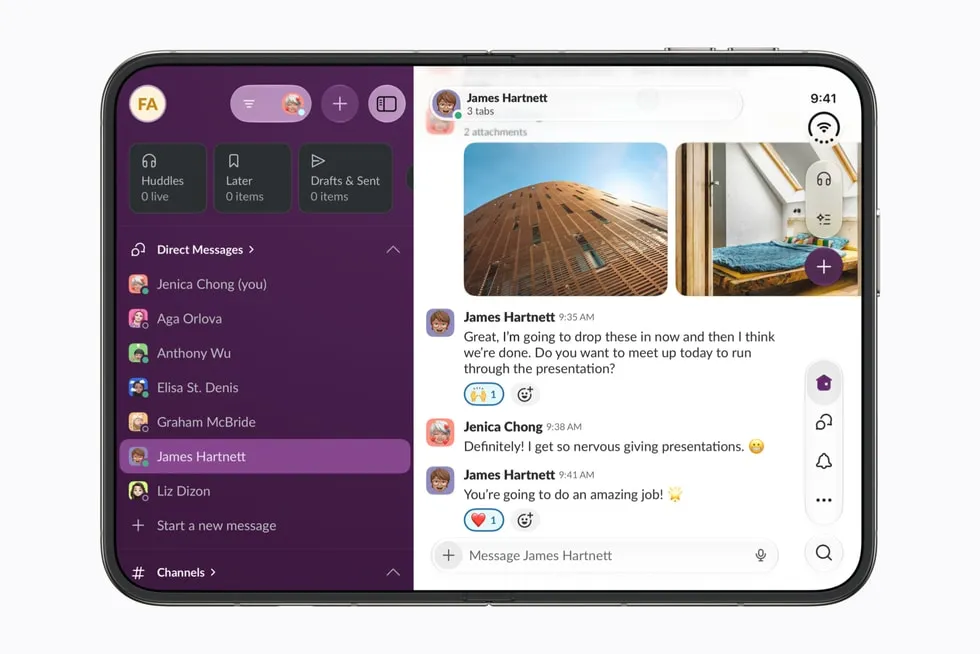
The display is probably the most important part of Apple's first foldable iPhone.
The iPhone Duo doesn't simply give you one large screen that folds in half. It has two displays: a 7.6-inch folding OLED display on the inside and a 5.4-inch OLED display on the outside.
When you need a compact phone, you use the outer screen. Open it up and you get Apple's largest iPhone display yet, with enough space for multitasking, gaming, watching movies and working across multiple apps.
Apple has also put considerable effort into the inner display itself. There's a custom nano-texture finish, wide-angle OLED technology, a new layer structure and a design intended to make the folding crease less noticeable.
Here's how the iPhone Duo display works and what makes it different.
iPhone Duo display specifications
Display feature | iPhone Duo |
|---|---|
Inner display | 7.6-inch Super Retina XDR OLED |
Inner resolution | 1878 × 2670 pixels |
Inner pixel density | 430 ppi |
Outer display | 5.4-inch Super Retina XDR OLED |
Outer resolution | 1398 × 2034 pixels |
Outer pixel density | 460 ppi |
Refresh rate | ProMotion up to 120Hz |
Peak outdoor brightness | 3,000 nits |
HDR brightness | Up to 1,600 nits |
Typical maximum brightness | 1,000 nits |
Minimum brightness | 1 nit |
Contrast ratio | 2,000,000:1 |
Always-On display | Yes |
Dynamic Island | Yes |
True Tone | Yes |
Wide color | P3 |
Apple Pencil | USB-C support |
Inner display finish | Nano-texture |
Both displays are Super Retina XDR OLED panels, with the inner display using a folding design. Apple says both screens support ProMotion with adaptive refresh rates up to 120Hz.
The iPhone Duo has two displays
The first thing to understand about the Duo is that the display experience changes depending on whether the phone is open or closed.
When folded, the 5.4-inch outer display gives you a conventional smartphone interface in a smaller footprint.
When opened, the 7.6-inch inner display becomes the main screen.
Apple says the inner display is 50% larger than the iPhone 18 Pro Max display, while the outer display provides 90% of the screen area of the iPhone 18 Pro.
That gives the Duo two very different personalities.
The outer screen is better suited to quick interactions and one-handed use. The inner screen is where the phone becomes much more useful for multitasking and immersive content.
How big is the iPhone Duo screen?
The inner display measures 7.6 inches diagonally.
It has a resolution of 1878 × 2670 pixels and a pixel density of 430 ppi.
The outer display measures 5.4 inches diagonally, with a resolution of 1398 × 2034 pixels and 460 ppi.
Interestingly, Apple has designed both displays around the same aspect ratio.
That means content can move between the two screens without suddenly looking dramatically different.
Apple says this consistent aspect ratio allows content to scale proportionally as you open and close the phone.
Why the same aspect ratio matters
A foldable phone can have a problem when its inner and outer displays have very different proportions.
An app might look fine on the outer screen but suddenly need to rearrange itself when the phone opens.
Apple's approach with the Duo is to keep the aspect ratio consistent across both displays.
As a result, content can transition between the outer and inner screens more naturally.
This is also part of the reason Apple has redesigned iOS 27 around the Duo's different positions.
When the phone opens, apps can take advantage of the extra space. For example, Split View allows two apps to appear side by side on the inner display.
What is the iPhone Duo inner display made of?
The inner screen is a Super Retina XDR OLED folding display.
Apple says the display is made using 10 ultra-thin layers, along with a custom nano-texture finish.
The construction is designed around the mechanical movement of the phone.
Instead of treating the display as a normal rigid panel, Apple has built multiple layers that can move as the device folds and unfolds.
The company says custom adhesives allow the display layers to glide past one another as the phone bends, helping relieve stress around the fold. A titanium plate underneath the display provides additional support.
What is the nano-texture display?
One of the most interesting parts of the Duo's screen is its nano-texture finish.
Apple uses the finish on the inner display to reduce glare and reflections.
Instead of giving the screen a completely glossy surface, the nano-texture layer creates a more matte appearance.
Apple says this also helps reduce the visibility of the crease.
The company's India product page describes the inner display as having a custom nano-texture finish designed to reduce glare, while the press release says the finish minimizes reflections and makes the crease less noticeable.
This is particularly useful on a large folding screen.
A traditional phone has a flat piece of glass reflecting light. A foldable display has a physical bending point that can catch reflections differently depending on the angle.
Reducing those reflections can make the center of the display less distracting.
Can you see the crease on the iPhone Duo?
There is still a physical fold in the display because the screen has to bend.
Apple's approach is to make that fold less noticeable rather than pretending it doesn't exist.
The inner display uses its multi-layer construction, custom adhesives and nano-texture surface to reduce the visual impact of the crease.
Apple says the display layers can glide past one another as the phone folds, which helps relieve bend stress and minimize the crease.
The result is intended to feel flatter and smoother when you're using the phone opened up.
How noticeable the crease is during everyday use will ultimately depend on lighting, viewing angle and what is displayed on the screen.
iPhone Duo display brightness
The Duo's displays are designed to remain visible outdoors.
Both displays support:
Up to 1,000 nits typical maximum brightness
Up to 1,600 nits peak HDR brightness
Up to 3,000 nits peak outdoor brightness
As low as 1 nit minimum brightness
They also support a 2,000,000:1 typical contrast ratio.
The 3,000-nit outdoor figure is particularly useful for a foldable phone because the large inner screen is likely to be used for video and other content in different environments.
The anti-reflective coating also works alongside the nano-texture finish to reduce reflections.
Does the iPhone Duo have 120Hz?
Yes.
Both the inner and outer displays support ProMotion with adaptive refresh rates up to 120Hz.
That means scrolling, animations and supported games can appear much smoother than they would on a conventional 60Hz display.
The refresh rate is adaptive, so the display doesn't simply run at 120Hz constantly.
It can adjust based on what you're doing, which helps balance smoothness with power consumption.
This is especially useful on the Duo because it has two displays and a large inner screen.
Always-On display and Dynamic Island
The Duo keeps some of the familiar iPhone display features.
Both screens support Always-On display and Dynamic Island.
Apple has redesigned the Dynamic Island for the foldable form factor.
On the Duo, it adapts to the orientation and position of the device rather than simply copying the layout used on conventional iPhones. Apple's iOS 27 design also moves certain controls to the side to make better use of the available vertical space.
So the Duo isn't just running the standard iPhone interface on a larger panel.
The software changes depending on how the phone is positioned.
What happens to the display when you fold the iPhone Duo?
The experience is designed to transition between the two displays.
You can start something on the outer screen, open the phone and continue using the larger inner display.
Apple describes the two screens as a continuous experience, with content adapting as the device opens, closes and changes orientation.
The phone can also be positioned in different ways.
For example, Apple shows the Duo being used:
Fully open for multitasking
Folded for one-handed use
At an angle for watching videos
Standing up for hands-free FaceTime
In StandBy mode for clocks, photos and widgets
The foldable design therefore changes more than the screen size. It changes how the screen can be positioned.
iPhone Duo display and multitasking
The 7.6-inch screen gives iOS considerably more room to work with.
One of the biggest additions is Split View, which allows two apps to appear side by side.
You can also open two windows of the same app.
For example, Apple specifically demonstrates using two Safari windows for comparison shopping.
That makes the inner display feel closer to a small tablet than a conventional smartphone screen.
You could have a webpage on one side while taking notes on the other, or keep a video visible while working in another app.
Does the iPhone Duo support Apple Pencil?
Yes.
Apple says the Duo will support Apple Pencil with USB-C, allowing users to take notes, sketch and mark up documents on either display. The feature is scheduled to arrive later this year.
This gives the 7.6-inch screen another practical use.
A large foldable display is already useful for documents and multitasking. Adding Pencil support makes it more suitable for handwritten notes and quick annotations.
What about the camera under the display?
Apple has also found a way to hide the inner FaceTime camera beneath the folding display.
The under-display FaceTime camera stays hidden when it isn't being used, allowing the inner screen to remain uninterrupted.
This is particularly useful on a foldable.
A traditional camera cutout would take up part of the large 7.6-inch viewing area.
With the camera underneath the panel, Apple can keep the inner display looking more like one continuous surface.
The outer display has a separate 12MP Center Stage camera.
Is the iPhone Duo display durable?
Apple has built several layers of protection around the folding panel.
The inner display uses a scratch-resistant coating and a nano-textured cover layer. Apple says the custom polymer used in the cover layer has up to 40% higher stiffness than other materials used in the industry.
High-strength glass sits above and below the folding display panel.
The phone also has a titanium plate underneath the display to provide additional support.
Outside the folding screen, the Duo uses Ceramic Shield 2 on the front and Ceramic Shield on the back. The device has an IP68 rating for water and dust resistance.
Foldable displays still need more care than a traditional rigid smartphone display, but Apple has clearly designed the Duo around durability rather than treating the folding panel as a disposable component.
Is the iPhone Duo display better than a regular iPhone?
That depends on what you want from your phone.
A regular iPhone has a simpler design and one large rigid display.
The Duo gives you something different: a compact 5.4-inch screen when closed and a 7.6-inch screen when opened.
The larger display is particularly useful for:
Watching movies and shows
Gaming
Reading
Editing photos and videos
Multitasking
Two-app workflows
Video calls
Taking handwritten notes with Apple Pencil
The trade-off is that you're buying a more complicated device with a folding display and hinge.
iPhone Duo display: What stands out?
The most interesting part of Apple's display isn't just the 7.6-inch size.
It's how Apple has connected the hardware and software around it.
You get a 7.6-inch OLED screen with ProMotion, 3,000-nit peak outdoor brightness, a nano-texture finish and a design intended to minimize the visible crease. The 5.4-inch outer screen keeps the phone usable when folded, while the shared aspect ratio helps content move between the two displays.
The result is closer to having two modes of one iPhone than simply having a phone with a screen that bends.
For quick tasks, keep it closed.
For movies, gaming, multitasking or larger workflows, open it up.
And that's really the point of the Duo's display: the screen changes with the way you use the phone.
If you're comparing the rest of the hardware, check our iPhone Duo specs guide. For the cost of getting into Apple's foldable lineup, see our iPhone Duo price guide.
Comments
No comments yet — be the first to comment.