
A20 Pro Chip Explained: Everything New in Apple's iPhone 18 Pro
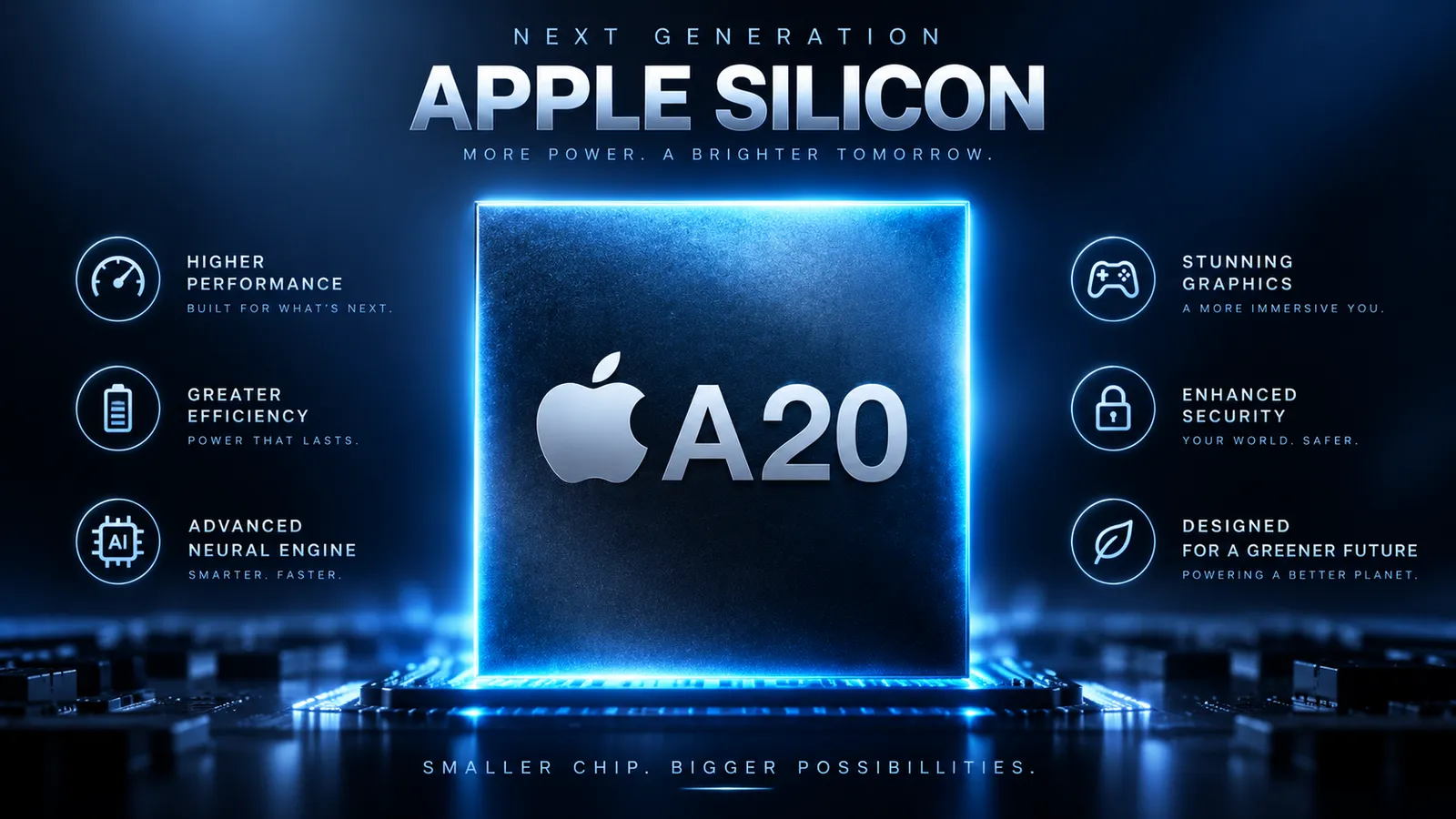
The A20 Pro is one of the biggest changes inside the iPhone 18 Pro and iPhone 18 Pro Max. Apple has moved to a new 2-nanometer manufacturing process, redesigned the chip packaging, added Neural Accelerators to the CPU, increased memory bandwidth and introduced a new Dual 16-core Neural Engine.
The result is a chip designed not just for faster apps and games, but also for the growing amount of AI processing happening directly on the iPhone.
Apple says the A20 Pro delivers up to 40% faster graphics performance than A19 Pro and up to 40% better sustained performance than the previous-generation iPhone 17 Pro when paired with the new vapor-chamber cooling system.
Here's what actually changed with the A20 Pro and why it matters for iPhone 18 Pro users.
What is the A20 Pro chip?
A20 Pro is Apple's latest high-end smartphone processor, built specifically for the iPhone 18 Pro and iPhone 18 Pro Max.
It combines several processing components into one system:
6-core CPU
7-core GPU
Dual 16-core Neural Engine
Integrated Neural Accelerators
Hardware-accelerated ray tracing
50% higher memory bandwidth than A19 Pro
Apple says the A20 Pro uses a 2-nanometer process, making it the first iPhone Pro chip built on this process generation.
The chip isn't simply about higher benchmark numbers. Apple has designed it around three areas that increasingly overlap on the iPhone: performance, AI and sustained workloads.
A20 Pro specs at a glance
Feature | A20 Pro |
|---|---|
Manufacturing process | 2nm |
CPU | 6-core |
CPU configuration | 2 performance cores + 4 efficiency cores |
GPU | 7-core |
GPU features | Neural Accelerators, hardware ray tracing |
Neural Engine | Dual 16-core |
Neural Engine cores | 32 total |
Memory bandwidth | 50% higher than A19 Pro |
Cooling | Next-generation vapor chamber |
Device | iPhone 18 Pro / 18 Pro Max |
Apple's technical specifications confirm the 6-core CPU, 7-core GPU with Neural Accelerators, Dual 16-core Neural Engine and hardware-accelerated ray tracing.
The biggest change: Apple's move to 2nm
The A20 Pro is built using 2-nanometer process technology.
Smaller manufacturing processes can allow chip designers to fit more transistor technology into a similar physical area while improving efficiency and performance.
Apple uses the new process as part of a broader redesign rather than treating it as the only source of the A20 Pro's improvements.
The chip also gets new packaging, higher memory bandwidth, additional AI hardware and a new cooling system.
For someone buying an iPhone 18 Pro, the practical result is less about knowing that the chip is 2nm and more about what the combination allows the phone to do.
A20 Pro CPU: six cores built for performance and efficiency
The A20 Pro has a 6-core CPU, consisting of:
2 performance cores
4 efficiency cores
The performance cores handle demanding workloads, while the efficiency cores are designed for lighter tasks that don't require maximum processing power.
Apple says the A20 Pro CPU can be up to 60% faster than the A19 Pro in some comparisons shown on its iPhone 18 Pro product page.
That's a substantial theoretical improvement, although the actual difference you'll notice depends heavily on the application.
Opening Messages or checking email won't suddenly feel dramatically different.
More demanding workloads are where the extra CPU performance becomes useful.
What does the faster CPU mean in everyday use?
The A20 Pro's CPU matters most when the iPhone is doing something computationally demanding.
Examples include:
Editing high-resolution photos
Rendering video
Running AI models
Processing large files
Gaming
Multitasking between demanding apps
Exporting video
Applying complex image effects
For ordinary tasks such as browsing, messaging and social media, the difference between recent iPhone generations is much less obvious.
The value of a faster CPU becomes clearer as apps become more demanding.
The 7-core GPU is a major upgrade
The A20 Pro uses a 7-core GPU with Neural Accelerators.
Apple says the GPU is up to 40% faster than A19 Pro and is designed to improve graphics rendering.
That matters most for gaming and other graphics-heavy applications.
The GPU also supports hardware-accelerated ray tracing.
What is ray tracing?
Ray tracing is a graphics technique that calculates how light interacts with objects in a virtual environment.
It can improve effects such as:
Reflections
Shadows
Lighting
Surface effects
Realistic environmental details
Hardware acceleration makes these calculations more practical for demanding mobile games.
The iPhone 18 Pro therefore has more graphics headroom for games that take advantage of these capabilities.
A20 Pro and gaming
Gaming is one of the easiest places to understand why sustained performance matters.
A phone may be extremely fast for the first few minutes of a demanding game. The challenge is maintaining that performance as the device heats up.
Apple's solution combines the A20 Pro with a much larger vapor chamber.
The company says this system provides up to 40% better sustained performance than iPhone 17 Pro.
That doesn't mean every game will run 40% faster.
Instead, it means the phone has more thermal headroom to maintain high performance during longer workloads.
That's especially useful for:
Long gaming sessions
3D games
Video rendering
AI workloads
Extended camera processing
Other sustained tasks
The Dual 16-core Neural Engine is built for AI
One of the most important changes isn't the CPU or GPU.
It's the new Dual 16-core Neural Engine.
Apple describes it as having 32 total cores, compared with 16 cores in the previous A19 Pro Neural Engine. Apple says this provides twice the AI processing capability.
The Neural Engine is designed for machine-learning workloads.
On the iPhone 18 Pro, that includes tasks such as:
On-device AI
Computational photography
Image processing
Intelligent camera features
Voice processing
Other machine-learning workloads
Apple specifically says the new Neural Engine accelerates on-device AI models and computational photography.
Why is the Neural Engine important for Apple Intelligence?
Apple is putting more AI processing directly on the iPhone.
That means the chip needs to process machine-learning workloads without sending every task to a remote server.
The A20 Pro's Neural Engine and Neural Accelerators are designed for this type of processing.
Apple says the chip provides faster Apple Intelligence through its Neural Accelerators, Dual 16-core Neural Engine and 50% higher memory bandwidth.
That matters as Apple adds more demanding AI features.
The more processing that can happen locally, the less dependent the phone is on sending certain tasks elsewhere.
What are Neural Accelerators?
Neural Accelerators are specialised hardware designed to speed up certain AI and machine-learning calculations.
The A20 Pro integrates them into its CPU architecture while also using the dedicated Neural Engine.
So Apple's AI processing system isn't relying on one component.
It has multiple pieces working together:
CPU → general-purpose processing
GPU → graphics and parallel workloads
Neural Accelerators → AI calculations integrated into the processor
Neural Engine → dedicated machine-learning processing
This division lets the system assign different workloads to hardware designed for them.
A20 Pro has 50% more memory bandwidth
Apple says A20 Pro provides 50% more memory bandwidth than A19 Pro.
Memory bandwidth is essentially how quickly data can move between the processor and memory.
That's particularly useful when the chip is handling large amounts of data.
High-bandwidth workloads include:
AI models
High-resolution image processing
Video editing
3D graphics
Large games
Complex computational photography
A faster CPU or GPU can still be limited if it can't get data quickly enough.
Increasing memory bandwidth helps reduce that bottleneck.
A20 Pro's new chip packaging
Apple has also changed how the A20 Pro is packaged.
The company says the design is inspired by its M-series chips. Instead of placing memory in the thermal path, Apple positions the silicon die alongside the memory, allowing the chip to attach directly to the next-generation vapor chamber.
This might sound like an engineering detail, but it has an important purpose:
getting heat away from the chip faster.
That's critical when the processor is operating at high performance for an extended period.
The vapor chamber is a big part of the A20 Pro story
The A20 Pro isn't working alone.
Apple has introduced a next-generation vapor chamber in the iPhone 18 Pro.
Apple says the new vapor chamber has three times the surface area of the previous generation and uses more thermally conductive materials.
The larger cooling system helps the phone maintain performance for longer.
Apple says the combination of the A20 Pro's new packaging and the vapor chamber enables up to 40% better sustained performance compared with iPhone 17 Pro.
This is arguably more useful than a short benchmark burst.
Why sustained performance matters
Imagine running a demanding game.
At the beginning, the processor may be running at high speed. As heat builds up, a phone can reduce performance to keep temperatures under control.
This process is commonly referred to as thermal throttling.
A better cooling system gives the chip more room to continue running at higher performance.
That's why Apple isn't talking only about peak A20 Pro performance.
It is also emphasising sustained performance.
For people who mostly use social media and messaging, this won't matter much.
For gamers, creators and people running AI workloads for long periods, it can matter considerably more.
A20 Pro and computational photography
You can also see the A20 Pro's impact in the iPhone 18 Pro camera system.
The phone has a new 48MP Fusion Main camera with variable aperture, along with new camera controls and computational photography features.
Apple says the A20 Pro's Neural Engine accelerates computational photography, while its Neural Accelerators support intelligent camera features.
The processor therefore isn't just responsible for making apps run faster.
It's involved in producing the final photo you see on the screen.
Tasks such as image processing, computational detail enhancement and intelligent camera features can require substantial machine-learning processing.
A20 Pro and the iPhone 18 Pro camera
The camera system itself gets major changes, including:
48MP Fusion Main camera
Variable aperture
48MP Ultra Wide
48MP Telephoto
Pro Controls
Photographic Styles 3
Smart Focus Tracking
Apple Reference Image
Advanced video processing
Apple's A20 Pro is part of the hardware foundation behind these features.
This is why the processor upgrade should not be judged only by CPU benchmark numbers.
A modern smartphone chip affects what the camera can do as much as how quickly an app opens.
A20 Pro and AI: why this generation matters
AI is probably the area where the A20 Pro will have the longest-term impact.
Apple says the chip is designed for more advanced on-device AI workloads and has twice the AI processing capability of A19 Pro through the new Dual 16-core Neural Engine.
The iPhone 18 Pro also introduces Siri AI, alongside Apple's broader Apple Intelligence features. Apple's product page specifically links the A20 Pro's AI hardware to faster Apple Intelligence.
As AI features become more sophisticated, having dedicated local processing becomes increasingly useful.
A20 Pro vs A19 Pro: What's actually new?
Here's the simplest comparison.
Feature | A20 Pro | A19 Pro |
|---|---|---|
Process | 2nm | Previous generation |
CPU | 6-core | 6-core |
GPU | 7-core | Previous generation |
Neural Engine | Dual 16-core | 16-core |
Neural Accelerators | Yes | Previous generation design |
Memory bandwidth | 50% higher | Baseline |
Ray tracing | Hardware accelerated | Hardware accelerated |
Sustained performance | Up to 40% higher than iPhone 17 Pro | Baseline |
Cooling | Next-generation vapor chamber | Previous-generation cooling |
The most notable architectural changes are the 2nm process, higher memory bandwidth, new Neural Accelerators, Dual 16-core Neural Engine and redesigned thermal system.
Does A20 Pro make iPhone 18 Pro faster than iPhone 17 Pro?
Yes, but the difference depends on the workload.
Apple says the iPhone 18 Pro's A20 Pro delivers:
Up to 60% faster CPU performance in Apple's comparisons
Up to 40% faster GPU performance
Up to 40% better sustained performance
The exact percentage varies depending on which generation Apple is comparing and which workload is being measured, so these figures shouldn't be treated as a universal speed increase for every task.
For everyday apps, you probably won't feel the full difference.
For gaming, AI, video editing and other heavy workloads, the additional headroom is more meaningful.
Does A20 Pro improve battery life?
A faster processor doesn't automatically mean longer battery life.
But a more efficient chip can perform a given workload using less energy, and Apple says the A20 Pro is designed to be both more powerful and more efficient.
The iPhone 18 Pro also benefits from a redesigned battery system and improved thermal management. Apple says the Pro lineup delivers significant battery-life gains compared with the previous generation.
So the A20 Pro contributes to battery efficiency, but you shouldn't attribute the entire battery improvement to the processor alone.
A20 Pro and the C2 modem
The A20 Pro also works alongside Apple's new C2 modem system.
C2 is a separate component, but Apple has designed it to work with the overall iPhone 18 Pro platform.
Apple says C2 provides AI-powered improvements to cellular quality and reliability, with faster uploads compared with C1X while using 15% less energy.
So the iPhone 18 Pro's performance platform isn't just the A20 Pro.
It includes the processor, cooling system, modem and wireless hardware working together.
Who will notice the A20 Pro upgrade most?
Not every iPhone 18 Pro owner will notice the same improvement.
Gamers
The faster GPU and improved sustained performance are useful for demanding 3D games.
Video creators
Rendering, editing and exporting high-resolution footage can benefit from additional CPU and GPU performance.
AI users
The Neural Engine and Neural Accelerators are particularly relevant as Apple expands on-device AI.
Photographers
Computational photography relies heavily on specialised processing, so the A20 Pro contributes to the camera experience.
Everyday users
You will still get a fast phone, but basic tasks such as messaging and web browsing don't require the full power of the A20 Pro.
Is A20 Pro worth upgrading for?
If you're moving from an older iPhone, the A20 Pro is part of a much larger upgrade that includes the camera, display, battery and other features.
If you're coming from an iPhone 17 Pro, the decision is different.
The A20 Pro is clearly more capable on paper, especially for AI and sustained workloads. But an iPhone 17 Pro is already powerful enough for normal everyday use.
The A20 Pro becomes a stronger reason to upgrade if you:
Play demanding games
Edit video on your phone
Use AI features heavily
Work with large files
Want more future headroom
Keep your iPhone for several years
If your use is mainly messaging, browsing, social media and photography, the processor alone probably isn't enough to justify replacing a recent Pro model.
A20 Pro explained: the bottom line
The A20 Pro isn't just a faster version of Apple's previous iPhone chip.
It combines a 2nm process, 6-core CPU, 7-core GPU, Neural Accelerators, Dual 16-core Neural Engine, higher memory bandwidth and a new thermal design.
The most interesting part may actually be the combination of the chip and cooling system.
The A20 Pro can deliver high peak performance, while the larger vapor chamber is designed to help maintain that performance during longer workloads. Apple says this combination delivers up to 40% better sustained performance than the iPhone 17 Pro.
For gamers and creators, that's a meaningful upgrade. For AI, the new Neural Engine and Neural Accelerators point toward where Apple's mobile hardware is heading next.
And for everyday users, the biggest benefit may be less obvious: the A20 Pro gives the iPhone 18 Pro enough processing headroom to handle increasingly demanding camera and AI features without relying entirely on the cloud.
Comments
No comments yet — be the first to comment.